
Block Schedule Info Under One Roof!
OVERVIEW

The subject of the 4 x 4 block and block scheduling in general is one of the leading conversational topics in contemporary educational circles today. In just a few years, countless individuals and groups have documented their opinions, impressions and experiences on this subject using a multitude of media. The variety of articles that I have investigated ranges from very short philosophical one liners to detailed reports of surveys and test results on it's effectiveness. It does seem that there is a never ending line of information available but after getting past the initial subject headings there is, thank goodness, a repetition that occurs. Even this report will be one of many that can be elicited to supply quick summary information and links to other sources. My main purpose is to give quick information on the latest developments with respect to this subject and to update it from time to time as more available information comes forth. Having been personally involved in discussions on this topic for the past 3 years, I am finding that the more recent information (mostly from the newly formed Internet web sites) shows a definite division forming over this topic. The division is clearly those who support the block vs. those that oppose the block. This situation was not that well-defined 3 years ago. At that time the advocates made the headlines simply because of the apparent newness of the proposal. But now as achievement test data is becoming more available the debate is starting to heat up. I anticipate that it will continue for quite some time especially due to the fact that there are so many variables and considerations to take note of.

In this publication you will be able to pick and choose what you want to investigate according to the topic headings. The information that is provided under each heading is summary information born from a variety of web sources. If you want to link to the specifics provided in each heading and to other sources they are there for you. In constructing this publication my intention is to give you quick, complete information that is to the point. You will not need to browse or make reference to other pages unless you desire to do so. I want to give you as much information as possible in one document to bear out as my title says: "...under one roof..."
CONTENTS

BLOCK SCHEDULE
The 4 x 4 block or block, simply defined, is a 4 period day schedule that is used in a junior or senior high setting instead of the standard 7 or 8 period day setting. Instead of having 6-7 classes per day for 45-50 minutes each for a whole year, students have 4 classes per day for 80-90 minutes each for a semester. During a typical school year students will have taken 8 classes in the block vs. 6-7 classes under the standard day setting. Below is a sample block schedule for one year:
|
BLOCK |
SEM I |
SEM II |
|
|
8:00-9:25 |
1ST |
ALG I |
BIO |
|
9:30-11:00 |
2ND |
ENG |
HIST |
|
11:00-11:30 |
LUNCH |
LUNCH |
|
|
11:30-12:00 |
ACTIVITY |
ACTIVITY |
|
|
12:00-1:25 |
3RD |
SCIENCE |
GEO |
|
1:30-2:55 |
4TH |
PHY ED |
ART |
Note that students complete a course in one semester under this schedule. There are no study halls. There are many versions of the above which most schools eventually employ. See SOME BLOCK OPTIONS, RESTRUCTURING PITFALLS, and ELEVA-STRUM SCHEDULE.
BLOCK ADVOCATE ARGUMENTS
The block has many attributes, the substantiated ones are listed below:
Less substantiated, more controversial attributes are:
The link list below contains many other excellent, varied proponent information sites: THE TROJAN BLOCK, LAFAYETTE BLOCK, BETHEL BLOCK ADVANTAGES (p.2,3), , 4 X 4 BLOCK, SMALL SCHOOL BLOCK ADVANTAGES, RECENT RESEARCH STUDIES, ADMINISTRATOR VIEWS, MINNESOTA SCHOOLS ON THE BLOCK, and other SCHOOLS ON THE BLOCK.
SCHOOLS USING THE BLOCK
The number of schools using the block is difficult to ascertain. The latest estimates range from 10% to 20% of schools currently using the block with estimates as high as 50% for schools on the block or planning to implement it. See INDIANA SCHOOL percentages.
TEACHING IN THE BLOCK
A typical teacher workload is 3 classes and 1 preparation period. There should not be any study halls and a minimum of supervision assignments since students are in their classes a majority of the time. Before any school installs the block it is recommended that several inservice sessions be provided staff members so that they can become more knowledgeable about the process. See STAFF DEVELOPMENT PROGRAM .
In order for teachers to have success in teaching in the 80-90 minute time frame, they will need to change their approach. Below is a sample one-block lesson plan:
FIRST YEAR FRENCH - SAMPLE LESSON PLAN
Telling Time:
-- 5 min. I. Warm-Up: Bonjour, classe. Ca va? (etc.)
-- 5 min. II. Administrivia: Roll-taking, passes, etc.
-- 5 min. III. Oral Practice: (look at clock) Quelle heure est-il?
Repetez: Quelle heure est-il? (several times, point to clock, look
at watch). Il est _____________. (repeating with real clock and watch)
-- 5 min. IV. Questioning Time: (Point to clock) Il est une heure?
Non, il est _________ (real time). Il est quaire heures? Non, il est
____________ (real time). Quelle heure est-il? (Hopefully, by now
students can give the real time.)
-- 10 min. V. Living Clock: (I become the clock using my hands as the
clock hands. I show the time with my hands. I state the time, and
students repeat. We go through all even hours. Now, I have all students
stand and become "living clocks." We again go through the even hours.)
-- 10 min. VI. Demonstration: (in forget language) Show me one
o'clock. Show me four o'clock. (Now, I mix up the hours in no
particular order. Students are still living clocks.)
-- 10 min. VII. Speaking: (I show students the hours with my arms;
they must say the correct time.)
-- 15 min. VIII. Formal Presentation: (Students receive a hand-out
with twelve clock faces on one side and one large clock on the other side.
Using an overhead, I will write "Quelle heure est-il?" and "Il est . . . ".
Students copy times for all clocks for side one.)
Teaching Minutes:
Repeat steps 5-8 (use the large clock on side two of the hand-out). I like
to concentrate on 1-30 minutes first, followed by an explanation of what
happens after 30. I tell them how logical it is to begin talking about the
next hour. Then I do 31-59 minutes at five minute intervals.
IX. Wrap-Up: Choral response, "Quelle heure est-il?"
(use transparency). Volunteer response. Reluctant student response.Quiz
Tomorrow: I will give the time and students will draw hands on clock
faces.
It is highly recommended that teachers do have a variety of activities to accommodate adolescent behavior tendencies. The plans are much more detailed but there are only three classes per day to account for. Check PLANNING FOR THE BLOCK, INSTRUCTIONAL APPROACHES (TABLE 6, etc.), TEACHING FOR 90 MINUTES, and OTHER LESSON PLAN SAMPLES.
RESEARCH DATA RESULTS
This section is the perhaps the most important in this document. The effectiveness of any new structure must be met with test data, which validates its existence. With respect to the block, testing has been limited because of its newness. I have found that the testing of student achievement in the block is an ongoing process with more reports being filed as of this writing. Most of the numerical research results are compiled and then presented in either table or graph format while other results that are somewhat subjective in nature, opinion surveys and polls, are presented in various other forms. Since the Canadians have been in the block transition for a longer period of time, their testing results is presented first. Also the numbers involved in their testing (30,000 students) lends credence as well.
The CANADIAN ASSESSMENT (1995) was made on students living in British Columbia in the science and mathematics areas. The assessment was made on students in 10 month (full year), semester and quarter timetable provincial schools. The various tables presented showed that the students in the 10-month programs OUTSCORED students in semester timetables, who, in turn, outscored students taking the same science course in a quarter system. The report concluded by the hypothesized benefits of semester and quarter systems, in terms of student achievement, are not being realized, at least in British Columbia.
A follow up study in 1996 called THE PROVINCIAL EXAM RESULTS expanded the testing into other academic areas. A graphic display of the results is shown below:
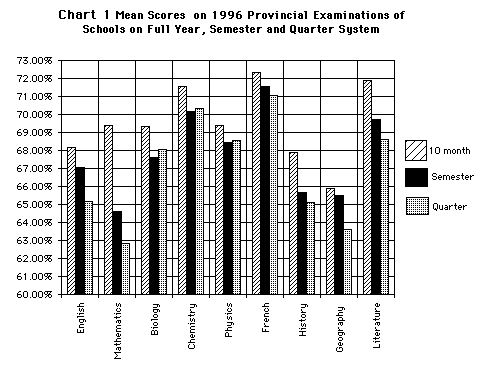
This report substantiates the 1995 report and beyond with its testing results in the other areas. In all subjects, students in the traditional 10-month schools OUTSCORED those in the other timetables. It is well to note that there are now more students in the semester schools in British Columbia than in the traditional 10-month schools.
This report was concluded with the following paragraph:
Often very important timetable decisions appear to be made based mainly on anecdotal evidence. It is hoped that information provided here on actual performance on common provincial examinations will help schools make decisions about timetables that work best for students...
The NORTH CAROLINA SURVEY, conducted an at then end of the 1995 school year, tested students in block and non-blocked schools with an End-of-Course Test (EOC). The following conclusions were noted overall:
The ANOKA-HENNEPIN REPORT was a survey performed in the four high schools in the Anoka-Hennepin School District in Minnesota. Two of the schools used the block while the other two had a 7 period day schedule. All four are good schools! Here are the published findings:
Finally, the VIRGINIA MUSIC EDUCATORS ASSOCIATION has conducted a survey of the effects of the block on the music curriculum in schools:
The above represents what I could find as far as objective, measurable results are concerned. This section will be revised in time. Other reports: WASSON HIGH and JEFF LINDSAY-LOCKWOOD REPORT.
BLOCK OPPONENT ARGUMENTS
As noted in my introduction, because of test data, various surveys, and experiences, there is a growing concern about the block with respect to its effectiveness and also its adherent structure. Below is a compiled list of the major concerns of block opponents:
The majority of the points listed are the results of the achievement test or the structure of the block itself. There is very little mention of the non-tested interests such as the attitudes and other intangibles associated with the block. The majority of the above concerns come from two publications: BLOCK CONCERNS and THE CASE AGAINST BLOCK SCHEDULING.
SCHOOLS THAT HAVE DROPPED THE BLOCK
There are a number of schools that have tried the block and have dropped it. The link, SCHOOLS THAT HAVE DROPPED BS contains a list along with a brief synopsis for some schools that have. It is well to note that there are some schools that have declared that they do not plan to implement the block: ELITE SCHOOLS.
OTHER INFORMATIONAL ITEMS
Here is some other information insights with respect to the block:
SUMMARY
Objective achievement testing shows no actual conclusive proof that students perform better in the block schools. The Canadian report bears out that students achieve better in the traditional setting. If one were to base the value of block scheduling on this data alone, there would be no reason to change to the block structure. This was one of the main premises for those who opposed the block.
When the focus shifts to structure, working climate, use of time, attitudes and stress factors, the block seems to be an improvement over the traditional structure. The block offers longer periods for different instructional methods and teaching strategies. It is also great for laboratory and shop classes.
I am sure that the block is here to stay. Even in British Columbia, there are schools that are currently adapting it. It seems that it has a great deal to offer if implemented with careful planning, patience and wisdom. It has failed in some systems while it has had success in others. The block has to be flexible to accommodate those curricula that do not naturally fit it. Above all, the community and the school board must be apart of the plans and the implementation if it is to succeed.